
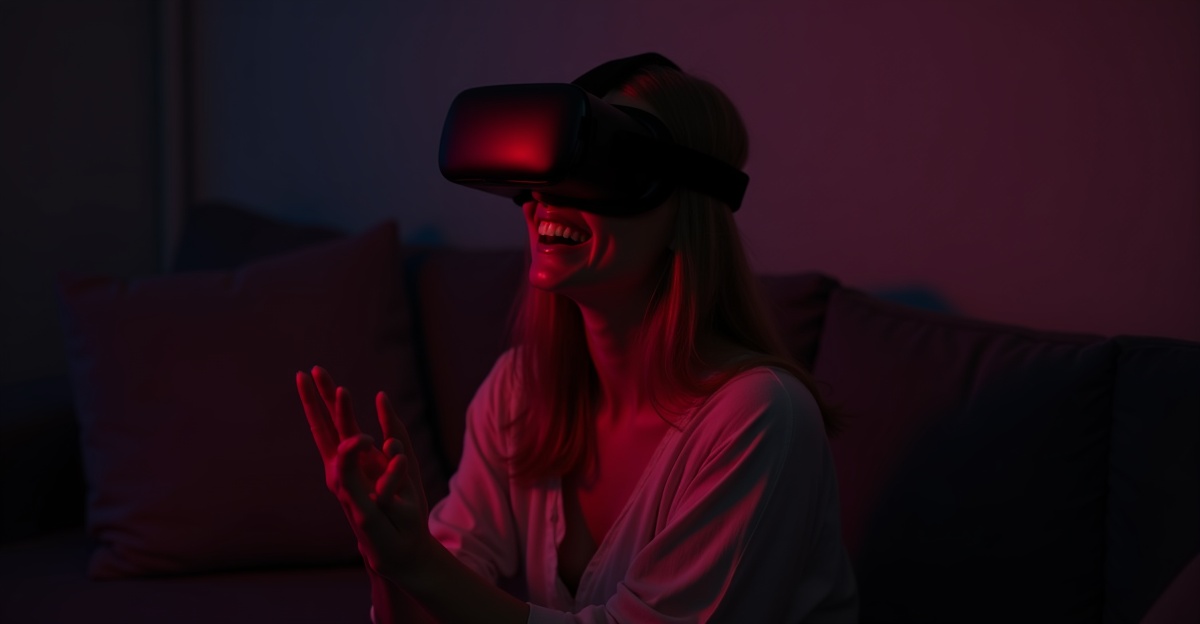
A body you feel close but that isn’t there. A voice whispering in your ear while you’re alone in your room. In 2026, research on’virtual intimacy has taken a leap that many didn’t expect. Stanford’s Virtual Human Interaction Lab has published data showing that shared experiences in virtual reality generate stronger feelings of presence and connection than traditional video calls. It’s not about prettier graphics or lighter headsets. It’s something psychological.
The feeling of having someone in front of you, even when it’s an avatar, activates brain circuits similar to those of physical interaction. Anyone working in the field knows it well: the difference between looking at a screen and wearing a headset is enormous. It’s not just visual immersion, but embodied presence. The body reacts as if the other person were really there, within reach.
This changes everything for those seeking intimacy through digital channels. Adult videochat platforms and digital intimacy models are already using this data to rethink their interfaces. It’s no longer just about seeing and talking. It’s about feeling.
The virtual reality economy in 2026 is already worth 58 billion dollars for augmented reality alone, with projected annual growth of 34%. Money drives innovation, but psychological research is moving faster than the market.
Embodied presence: what changes for desire
The underlying idea is simple and powerful: when two people share a virtual space in real time, the brain stops distinguishing between real and simulated. Not entirely, but enough to generate a genuine emotional and physical response. The Stanford study measured participants’ heart rate, skin conductance, and self-assessments. The results show that intimacy in VR activates the same brain areas involved in romantic and sexual attachment.
Those who follow the field already know. Seeing it confirmed with solid data still hits home. Until a few years ago, digital mediation was thought to be just a stopgap, a pale copy of real contact. Today we know it can be an experience in its own right, with its own specificity.
The fundamental difference compared to a video call is bodily synchrony. In VR, head, hand, and torso movements are tracked and reproduced on the other person’s avatar. This creates a perceptual loop that our nervous system interprets as real presence. The avatar doesn’t need to be photorealistic. It just needs to be responsive.
The implications for sexuality are enormous. You can engage in role play immersive sex with a partner on the other side of the world, without needing to travel. You can explore dynamics of power exchange in safe and controlled contexts. You can live out fantasies that would be impossible or dangerous in physical reality.
It works.
Health and VR: the clinical side of digital intimacy
The VR Healthcare Global Symposium in Tampa Bay, in 2026, dedicated an entire session to the use of immersive virtual reality for sex therapy. Dr. Sarah Ball, a researcher at Creighton University, presented data on the use of IVR to treat desire disorders and relationship dysfunctions. Preliminary results show that gradual exposure to virtual intimacy scenarios can reduce performance anxiety and improve couple communication.
It’s not pornography. It’s a controlled environment where difficult conversations, moments of vulnerability, and exchanges of intimacy can be simulated without the weight of immediate judgment. The ability to pause, rewind, and try again removes the pressure that often blocks real people.
This opens scenarios even for those living in conditions of forced isolation: people with disabilities, lonely elderly people, long-term care patients. The sexual wellbeing is not a luxury, it’s a component of mental health. VR can become a tool to guarantee everyone the possibility of living experiences of intimacy, even when the physical body does not allow certain interactions.
There are those who turn up their noses.
I understand.
The idea of simulated intimacy is frightening, it seems like a replacement for the real thing. But the data say otherwise: people who use VR for intimate relationships don’t abandon physical ones. If anything, they learn to communicate better, manage expectations, and negotiate boundaries. Virtual practice becomes training for real life, not an escape.
Safety and consent in a non-physical world
The question of consent in virtual environments is complex and still in the process of legal definition. What does it mean to violate an avatar’s personal space? Does the concept of harassment exist in VR? Courts are beginning to rule on it, but regulation is years behind the technology.
Some platforms have introduced distance bubble features: an invisible sphere around the avatar that prevents others from getting closer than a certain threshold without explicit consent. Others are developing reporting systems based on the analysis of virtual proxemics. It’s not science fiction. It already works today.
For those who practice BDSM BDSM in VR, the rules are the same as in the real world: prior negotiation, safe words, aftercare after the session. The difference is that here you can’t physically touch each other, but the emotional impact is real. Aftercare after a virtual scene matters as much as after a live one.
We must not underestimate the psychological power of these experiences. A virtual hug can trigger the same neurochemical reactions as a real one. A word said in VR can hurt like one said in person. Responsibility doesn’t change just because the medium is different.
Sources and references
Sources:
- Psychology of Online Love: Are Digital Relationships Real? (2026 Research)
- Virtual Reality and Healthcare Global Symposium ’26
- The Augmented Reality and Virtual Reality Industry 2026
- Kinsey Institute – Research on intimacy and technology
- NCBI/PubMed – Studies on VR and emotional presence
Want to go from theory to practice?
Hundreds of performers are live right now, waiting for you on the videochat.
Join the videochat →