
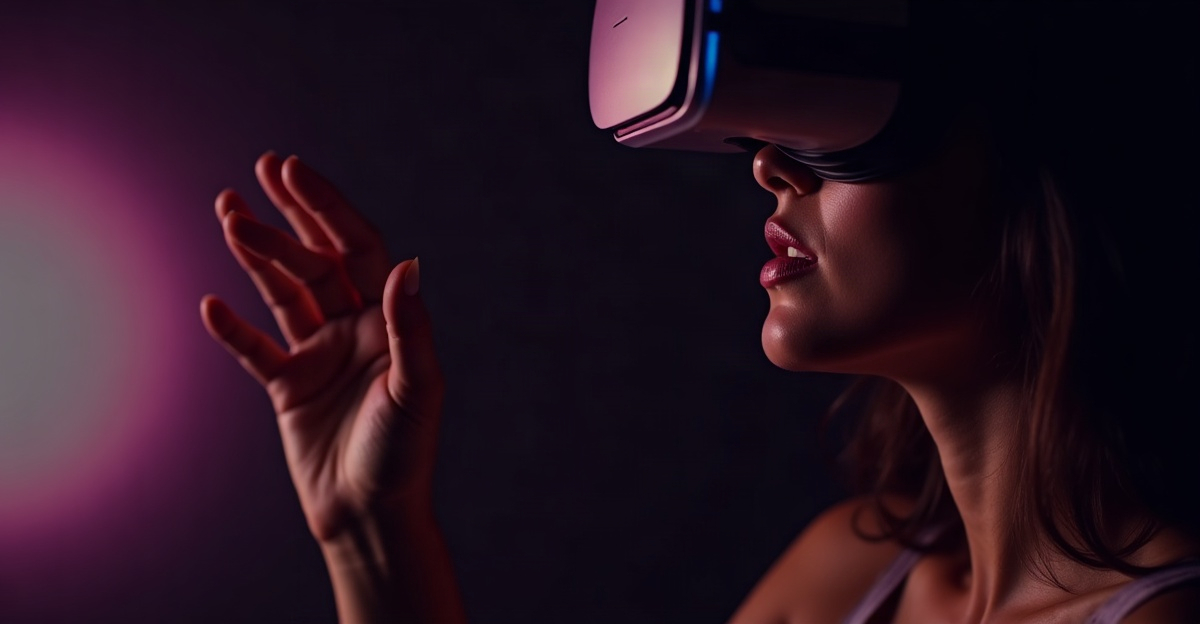
The debate is over. The virtual reality is no longer a tech trade-show curiosity, but a concrete terrain where people build bonds, arousal, and emotional closeness. Research published in the first months of 2026 has a different tone: it no longer asks whether it works, but how it is already redrawing the boundaries of desire.
It is not an empty simulation. Those who use it consistently know this well.
Immersive adult platforms have grown quietly but steadily, and academic studies are beginning to look closely at what happens behind the headsets. The result is less predictable than it seems.
What is intimacy in virtual reality
Intimacy in virtual reality is about the psychological closeness that forms when two people share a simulated space without their bodies touching. It is the terrain of digital intimacy, a form of contact that passes through avatars, gestures, and voices mediated by a platform.
The brain does not make clear distinctions. A systematic review published in Frontiers in March 2026 on virtual humans shows that sociability, graphical fidelity, and expressiveness are the three axes that make a digital presence credible enough to trigger a real emotional reaction. A perfect rendering is not necessary; a coherent social response is.
Fidelity only matters up to a point. According to the study, the real glue is the virtual interlocutor's ability to read cues and respond credibly. And this explains why many adults feel a connection they describe as authentic.
The psychological finding: disinhibition and pleasure
The 2026 essay by netpsychology.org on the psychology of online love puts into order a process that until recently was only intuition. Digital attraction follows the same neurochemical pathways as physical attraction: dopamine, anticipation, intermittent reinforcement. Notifications—messages that arrive intermittently—work like an emotional slot machine.
This is no trivial matter. The body reacts even without contact.
Research explains that online disinhibition, that feeling of being less exposed to judgment, accelerates intimate openness. You confess sooner, you explore sooner. The digital relationships become a space where desire tries to come out without the weight of live performance. This doesn't make them less real; it makes them different.
Another study published in April 2026 in Frontiers in Psychology measured the impact of virtual reality on curiosity, joy, and engagement. The results show that immersion increases curiosity and lowers emotional defenses, two conditions that matter a great deal in erotic play. VR isn't just a screen; it's an environment that engages almost the entire perceptual system.
From fantasy to relationship: what really changes
The shift from solitary fantasy to mediated relationship isn't automatic, but it's more frequent than people admit. The review on virtual humans lists precisely this: the sociability, the ability to respond to social cues, is what drives a person to return. When it's missing, the experience empties out quickly.
The parasocial interaction with a virtual human or with a live-streaming performer can become an intense emotional attachment. The line between entertainment and relationship grows thin, especially when the algorithm learns to personalize responses. People who fall for it aren't naive; they're simply human.
In 2026, the question is no longer whether VR can replace human contact. The question is how many adults will use it to avoid giving up desire when the body, for one reason or another, can't be there. The answer isn't in newspaper headlines; it's in the usage data of immersive platforms for adults.
Safety and consent
In VR, consent is negotiated before you even put on the headset. You need an explicit conversation about limits, just like in a live scene. It consent dynamics doesn't get simplified just because the bodies are separate—on the contrary: the absence of physical feedback makes it easier to misread the other person's discomfort.
Practitioners aftercare After a BDSM scene, they know that the emotional comedown matters as much as the scene itself. With virtual reality it works the same way: after an intense session, a debriefing is needed, even if no one touched anyone. The nervous system doesn't recognize the difference between a physical gesture and one simulated with enough fidelity.
You don't need a manual; you need honesty. And the willingness to stop when pleasure stops being recognizable.
Sources and references
Sources:
- Frontiers | Virtual humans in virtual reality: a scoping review on sociability, fidelity, and expression
- Psychology of Online Love: Are Digital Relationships Real? (2026 Research)
- Frontiers | The impact of virtual reality on curiosity, joy, and engagement
- Kinsey Institute
The 2026 review examined dozens of studies: no one hypothesizes anymore that VR is just a game. It's a fact, not a hope.
How long will it be before sex clinics prescribe it as support for desire?
Want to go from theory to practice?
Hundreds of performers are live right now, waiting for you on the videochat.
Join the videochat →